How long is a football match? Half-time, added time and extra time explained
A football match is 90 minutes: two halves of 45 minutes, plus the time the referee adds for stoppages. With half-time it takes about an hour and 50 minutes, and longer if it goes to extra time and penalties.

By Steffen Fonvig · Published · 3 min read
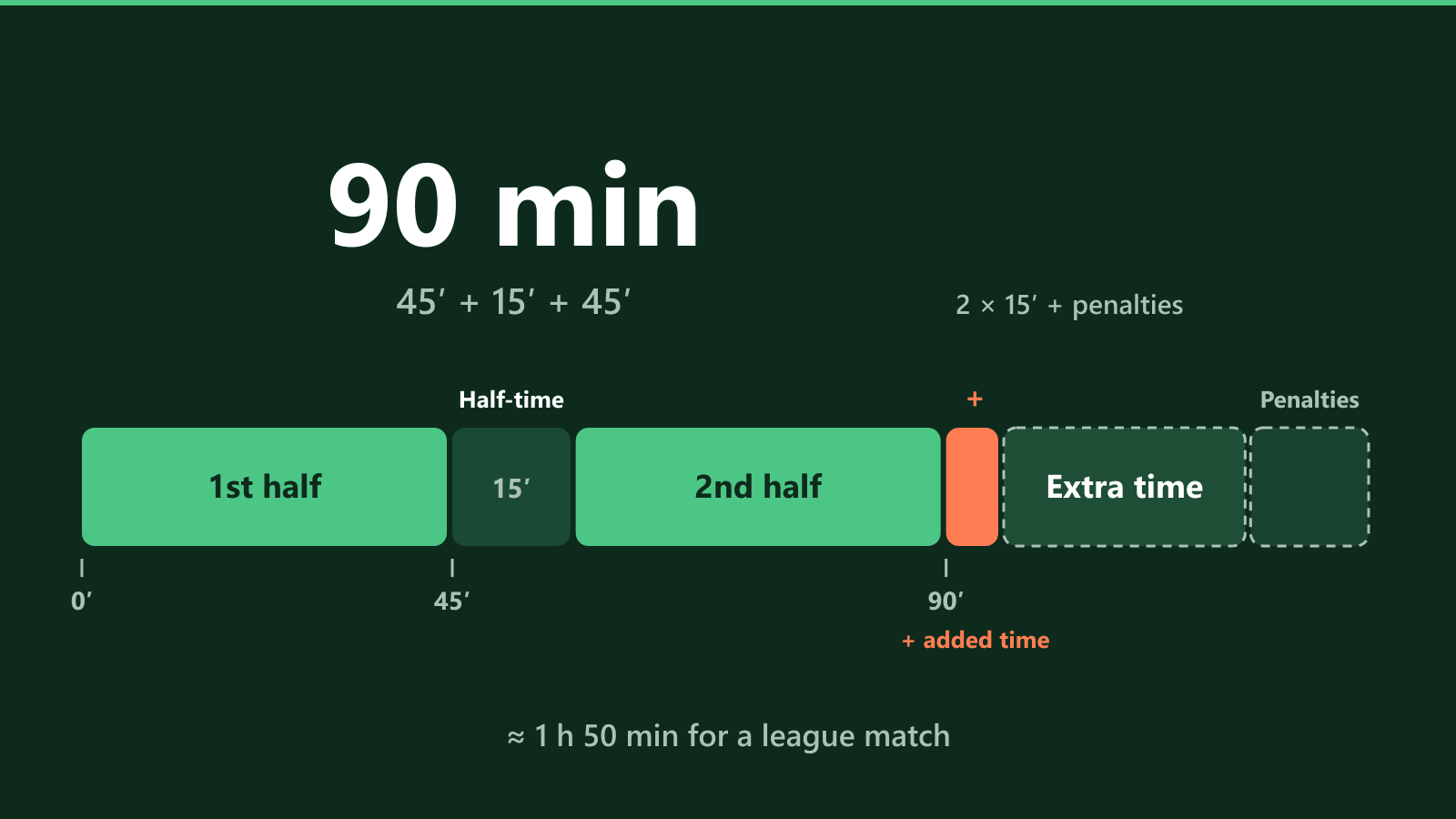
A professional football match lasts 90 minutes, played as two halves of 45 minutes. The referee adds time at the end of each half for stoppages, and the two halves are separated by a half-time break of up to 15 minutes. Allow roughly an hour and 50 minutes from kick-off to the final whistle for a normal league match.
The 90 minutes: two halves of 45
Law 7 of the Laws of the Game says a match lasts two equal halves of 45 minutes. The length can only be shortened if the referee and both teams agree before kick-off and the competition’s rules allow it, which is common in youth football, veterans’ football and some amateur leagues.
The clock does not stop when the ball goes out of play. Instead, the referee keeps track of time lost and adds it at the end of each half.
How long is half-time?
Players are entitled to a half-time interval of no more than 15 minutes. The competition’s rules set the exact length, and in the Premier League, the EFL and the major European competitions it is 15 minutes. The referee can only change it with good reason.
Added time: why matches run past 90 minutes
Added time (also called stoppage time or injury time) makes up for time lost during each half. The Laws list what counts:
- substitutions
- assessing and removing injured players
- time-wasting
- disciplinary sanctions such as cautions and sending-offs
- medical stoppages allowed by the competition, such as drinks and cooling breaks
- VAR checks and reviews
- goal celebrations
- any other significant delay, for example to a restart
Near the end of each half the fourth official holds up a board with the minimum added time. The referee can play longer than that if more time is lost during the added minutes, but never less. If a penalty kick is awarded as time runs out, the half is extended until the penalty has been taken.
Time-wasting is also tackled at its source. A goalkeeper who holds the ball for more than eight seconds now concedes a corner kick to the other team.
Extra time and penalties
Most league matches can end in a draw. In knockout football, such as the FA Cup, the Champions League knockout rounds or a World Cup final, a winner is needed, so a drawn match can go to:
- Extra time: two periods of no more than 15 minutes each, with a short break of up to one minute for drinks between them, but no half-time interval.
- Penalties (officially “kicks from the penalty mark”): if it is still level, each team takes five kicks, alternating. If they are still level after five each, the shoot-out continues one kick each until one team scores and the other misses.
Not every cup tie uses extra time: some competitions go straight to penalties after 90 minutes, so check the rules of the competition you are watching.
How long does a match take in total?
| Match | Typical total time |
|---|---|
| League match (90 min + added time + 15 min half-time) | About 1 hour 50 minutes |
| Cup match with extra time | About 2 hours 25 minutes |
| Cup match with extra time and penalties | About 2 hours 40 minutes |
These are typical figures, not fixed ones: added time varies from match to match. To see what is on today, with kick-off times in UK time, check today’s football scores or tomorrow’s fixtures.
Women’s and youth football
Women’s football uses the same Laws, so adult women’s matches also last 90 minutes. Youth matches are shorter, and each competition sets the length by age group.
More football basics
New to the game? Read our guides to the offside rule, how big a football pitch is and football positions.