The offside rule explained: what is offside in football?
Offside in one sentence: when a team-mate plays the ball, an attacker in the opponents’ half must not be nearer the goal line than both the ball and the second-last defender, if they then get involved in play.

By Steffen Fonvig · Published · 3 min read
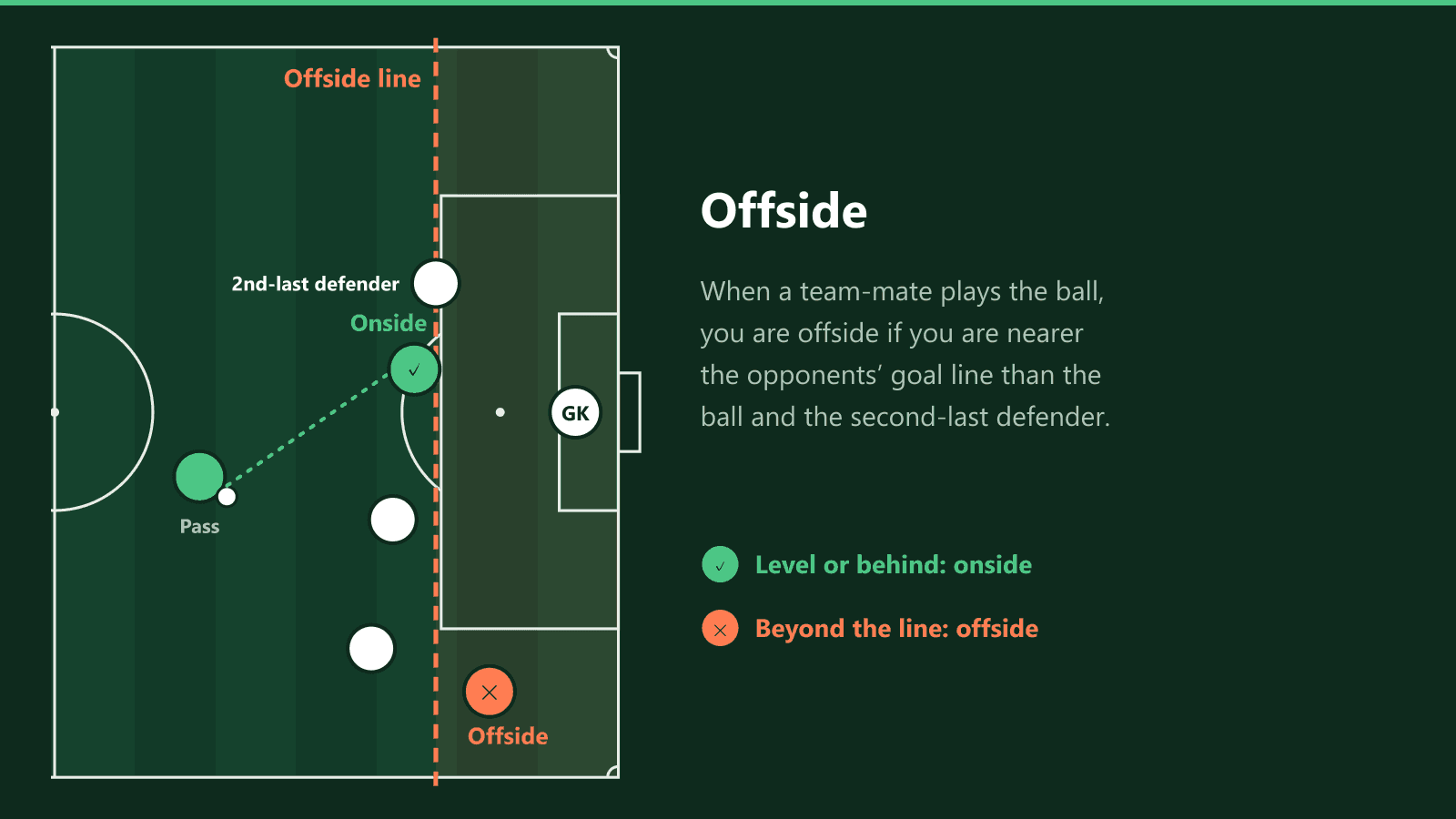
In one sentence: when a team-mate plays the ball to you, you are offside if you are in the opponents’ half and nearer their goal line than both the ball and the second-last opponent, and you then get involved in play. The second-last opponent is usually the last outfield defender, because the goalkeeper is normally the last.
The rule is Law 11 of the Laws of the Game. It has two parts: being in an offside position, and committing an offside offence.
Part 1: the offside position
A player is in an offside position if any part of their head, body or feet is:
- in the opponents’ half (the halfway line itself does not count), and
- nearer to the opponents’ goal line than both the ball and the second-last opponent.
Three details settle most arguments:
- Level is onside. A player level with the second-last opponent, or level with the last two opponents, is not offside.
- Arms and hands don’t count, for attackers, defenders and goalkeepers alike. For offside purposes the arm starts at the bottom of the armpit.
- Behind the ball is onside. A player who is behind the ball when it is played cannot be offside.
Being in an offside position is not an offence on its own. A player can stand in an offside position all match without being penalised.
Part 2: when it becomes an offence
The moment that matters is when a team-mate plays or touches the ball. A player in an offside position at that moment is only penalised if they become involved in active play by:
- interfering with play: playing or touching the ball passed or touched by a team-mate;
- interfering with an opponent: for example blocking the goalkeeper’s line of sight, challenging for the ball, or clearly trying to play a ball that is close to them when this affects an opponent;
- gaining an advantage: playing a ball that rebounds or is deflected to them off the goalpost, crossbar, match official or an opponent, or that comes from a deliberate save.
Where the attacker is when the ball arrives does not matter. What counts is where they were when their team-mate played it, which is why a player can sprint past the last defender after the pass and still be onside.
When you can’t be offside
There is no offside offence if the player receives the ball directly from:
- a goal kick,
- a throw-in, or
- a corner kick.
A deliberate play of the ball by a defender also resets the situation: an attacker who receives the ball after a defender deliberately plays it (other than a deliberate save) is not penalised for offside, even if they were in an offside position.
What happens after an offside
The referee awards an indirect free kick to the defending team from where the offence happened, including when that is in the offending player’s own half. In practice, the assistant referee raises the flag, and the referee blows the whistle.
Offside and VAR
Assistant referees often keep the flag down in tight situations and let play continue, so that VAR can check a goal afterwards. If play were stopped wrongly, a legitimate goal chance would be lost for good. In competitions that use it, semi-automated offside technology tracks the players’ positions and helps draw the line quickly.
Why does football have an offside rule?
Without it, attackers could wait next to the opponents’ goal for long balls. Offside pushes teams to build attacks together and keeps the play compact, which is why it has been part of the game in some form since the earliest rules.
More football basics
Read our guides to how long a football match lasts, how big a football pitch is and football positions, or follow today’s football scores.